
Backtesting Trading Strategies Before You Scale Live
Learn how backtesting trading strategies turns gut feelings into written rules. Prove the book on paper first so you stop negotiating every candle.
What Backtesting Trading Strategies Really Means
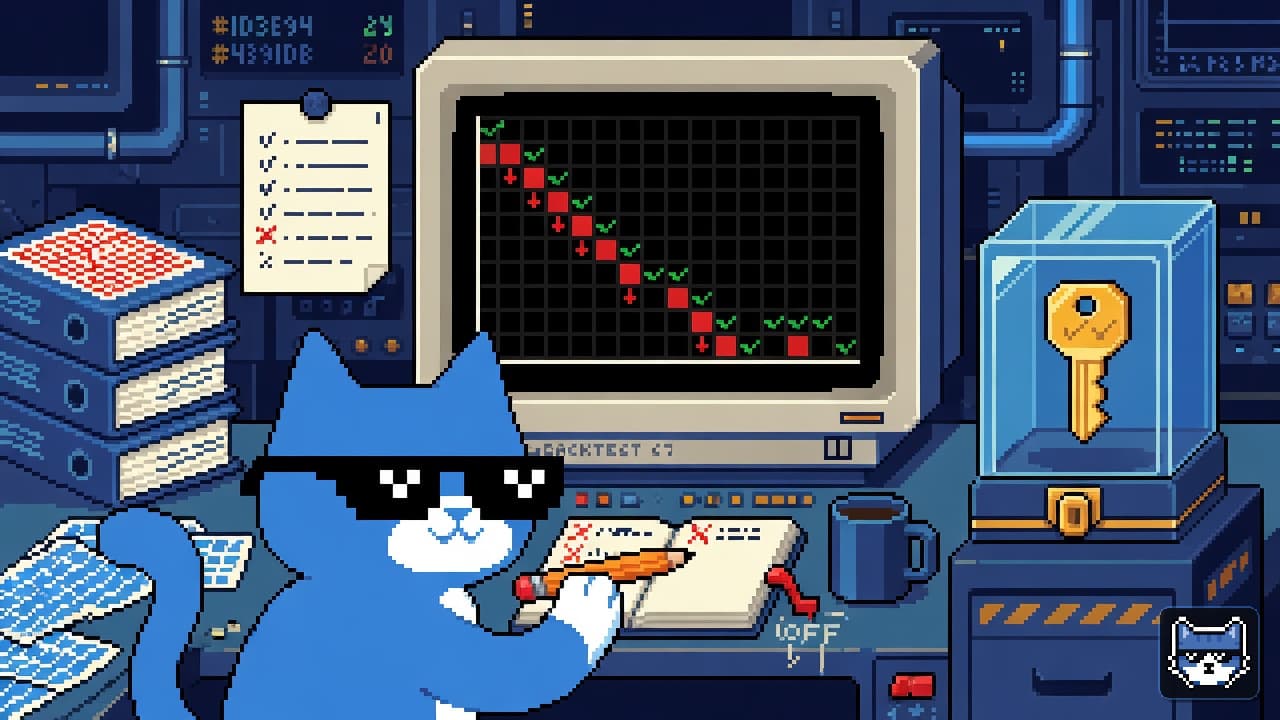
Backtesting trading strategies means you run your written rules against past data before you risk live size. It is how you stop negotiating with yourself on every candle: the rules already answered the hard questions when the room was quiet. You are not hunting a magic equity curve. You are checking whether the process holds under boring, ugly, and slow conditions so you can trust it when the market gets loud.
Most traders skip that step. They draft a rule in their head, open a chart, and start clicking. The plan lasts until the first red hour, then mood takes the wheel. Backtesting is the opposite habit. You invent the process, sample it, kill what fails, and only then decide whether live capital is even on the table.
This is educational process, not a promise of profit. Markets change. Paper is not live. Your job is still capital control.
Why Gut Feels Fast And Fails Slow
Emotion-driven trading feels productive because you are always doing something. You resize on fear. You chase after a wick. You reopen after a stop "just once." None of that is a strategy. It is a string of negotiations with yourself.
A written rule set removes the debate in the moment. Entry criteria, invalidation, size caps, and session kills live on the page before the candle prints. Backtesting asks a plain question: if I had followed these rules on this sample, what would the path look like, and where does the plan break?
People drop backtests for three common reasons:
| Reason they quit | What actually happened |
|---|---|
| Curve looked ugly | The sample told the truth early |
| Too many filters | They optimized for comfort, not process |
| Wanted action now | Dopamine beat proof |
Ugly results are useful. They are cheaper than the same lesson on live size. The goal is not a smooth screenshot. The goal is a rule book you can still run on a bad Tuesday.
Write The Rules Before You Touch History
Backtesting without a fixed rule book is just hindsight shopping. Write the strategy in plain language first.
- Market and timeframe. What you trade and on what clock. One lane beats twelve half-defined ideas.
- Entry. Exact conditions. No "looks strong" language.
- Invalidation. When the idea is wrong. A stop is a rule, not a mood.
- Size and risk. Max risk per trade, max open risk, daily loss kill.
- Session boundaries. When you are allowed to act, and when the system is flat.
- Promotion and kill criteria. What must hold on paper before you arm live. What forces a pause.
If a rule needs a paragraph of excuses, it is not a rule yet. Tighten it until a stranger could apply it the same way you would.
Only after the page is stable do you pull history. That order matters. Invent and prove process before you scale live size. Otherwise you reverse-engineer a story that flatters last month and collapses next month.
How To Run A Clean Sample
Treat the sample like a lab, not a highlight reel.
Define the window. Use enough history to include quiet periods, spikes, and regime shifts you care about. One lucky month is not a sample.
Apply rules mechanically. No skipping losers because "that was different." If the rule would have taken the trade, the trade is in the log.
Log the path, not only the total. Drawdowns, streaks, time in market, and rule breaks matter more than a single end number. A strategy that wins on paper only by ignoring its own stops is not proven.
Separate build data from check data. If you tune on the same stretch you judge, you will overfit. Hold out a slice you do not touch while inventing filters.
Record failure modes. Where did size blow up? Where did the edge vanish? Where did you want to override the plan? Those notes become your live checklist.
A simple table helps you stay honest:
| Check | Pass signal |
|---|---|
| Rule clarity | Same entry twice, same result |
| Risk caps | No single trade can end the book |
| Kill switch | Daily or streak limit actually stops you |
| Holdout | Out-of-sample path still usable |
| Override urge | You know when you would have cheated |
Pass does not mean "always profitable." Pass means the process behaved like the process you wrote.
Common Traps In Backtesting Trading Strategies
Overfitting. Adding filters until the curve is pretty. You did not find edge. You fitted noise. Prefer fewer rules that survive a second window.
Survivorship and clean data lies. Missing delisted names, ignoring fees, spreads, slippage, and partial fills will paint a fantasy. Haircut the numbers. Assume worse fills than your ego wants.
Lookahead. Using information that was not available at decision time. If the signal needed the close and you entered mid-bar with future knowledge, the test is fiction.
Strategy hopping. Killing a book after ten trades because boredom arrived. Sample size and prewritten kill criteria beat vibes.
Confusing paper with live. Execution, emotion, and liquidity differ. Paper first is mandatory. It is still not a certificate. You arm live only when you mean it, with caps you can survive.
Optimizing for dopamine. Designing rules that create constant action instead of stable expectancy under risk limits. Run the system, not the dopamine.
When a trap shows up, do not argue with the log. Fix the rule or retire the book.
From Paper Proof To Live Arming
Paper is the rehearsal. Live is a different stage with real cost of error.
Move size only after:
- Rules are stable enough that you are not rewriting them every session.
- The sample includes the boring stretch, not only the highlight stretch.
- Risk arms are explicit: position limits, daily loss kill, and a way to stay flat.
- You can explain the strategy in one short paragraph without jargon stacks.
Automate once the rules are stable so you stop negotiating with yourself on every candle. Automation is not a substitute for a bad plan. It is enforcement for a plan you already proved you can state cold.
Keys stay yours. You decide when capital is armed. That is the control loop: design, sample, pause losers, promote only what holds, keep human authority over size.
Venues are examples of where the same philosophy can run. A prediction market book, a spot pair, or a simple systematic idea all need the same spine. The product is the system, not a souvenir chart from one venue.
Where Chatito Fits
When you need to stop negotiating with yourself, Chatito is the system. The work is still yours: write the rules, demand paper proof, and keep capital control. Chatito is built around that order. Paper first. You arm live. Keys stay yours.
Use backtests to invent and kill ideas before size. Use written policy so live sessions do not become midnight debates. Growth through education and problem-solving beats another tip feed that resets your mood every hour.
Join the waitlist if you want the system, not another feed.
Short Risk Note
Not financial advice. Trading and prediction markets involve risk of loss. Past or paper results do not guarantee future performance. Backtests can mislead when data, costs, or regimes are wrong. Never risk money you cannot afford to lose.
Strategies over emotions. Prove the book. Then decide whether live size deserves a seat.
Not financial advice. Trading and prediction markets involve risk of loss. Past or paper results do not guarantee future performance.
FAQ
- What does backtesting trading strategies mean in plain terms?
- It means you apply fixed written rules to historical data and study the path before you risk live size. You are checking whether the process holds, not hunting a guaranteed curve.
- How much history do I need for a useful backtest?
- Enough to cover quiet periods, spikes, and the conditions you claim the rules handle. One hot month is not enough. Prefer a build window and a separate holdout window you do not tune on.
- Why do my backtests look great then fail live?
- Common causes are overfitting, ignored fees and slippage, lookahead bias, and rewriting rules mid-sample. Paper also skips live emotion. Treat paper as proof of process, then arm small with hard kills.
- Should I automate before or after backtesting?
- After. Invent and prove the rules first. Automate once they are stable so you stop re-deciding every candle. Automation on a fuzzy plan only speeds up mistakes.
- How does Chatito relate to backtesting?
- Chatito is a system so you stop deciding every candle by mood. Paper first. You arm live. Keys stay yours. Not signals. Not a vault.
Not financial advice. Trading involves risk of loss. Paper ≠ live.