
Risk Management For Trading Systems: Caps, Kills, And Spend Limits
Risk management for trading systems is hard limits: size, daily loss, kill switches, and spend caps. Automation without risk is just faster ruin.

Risk management for trading systems is the walkaway you write before the table. Caps, kills, and spend limits so 2am-you cannot reopen the deal. Strategies hunt edge. Risk keeps you solvent while you search. Automation without this layer is just faster ruin.
When you need to stop negotiating with yourself, you write a risk policy first. Mood is not a limit. A number in config is.
Risk Is A Layer, Not A Vibe
In systematic trading, risk lives in code and config, not in a pep talk after a red candle.
- Max size per market
- Max open strategies
- Max daily loss
- Max drawdown kill
- Correlation or inventory caps when the book can pile the same bet
If the rule is only in your head, it will vanish after two losses. That is the whole point of encoding it. You are not trying to feel more disciplined. You are trying to make the next click illegal.
A useful test: can a stranger run your book from the written policy and hit the same stops? If they would have to "use judgment," you still have a vibe.
Core Controls
| Control | Purpose |
|---|---|
| Position limit | Stops single-market blowups |
| Portfolio cap | Stops death by a thousand books |
| Daily loss kill | Ends the session before tilt |
| Kill switch | Human or system emergency stop |
| Size tiers | Prevents fake confidence from tiny wins |
Write the number. Write what happens when it fires. Write whether the book flattens, freezes, or only stops new entries. A kill that "usually" fires is not a kill.
Daily loss is the most ignored control because it feels like quitting. It is not. It is how you keep tomorrow's sample clean. Revenge entries after a kill are a new strategy you did not write.
Spend Caps And Keys
When software can invent or trade, capital ring-fencing matters. Do not confuse that with depositing into a box.
- You do not deposit your wallet into Chatito
- You do not hand master keys to a bot environment
- You do set a spend cap the strategy cannot exceed
- You do keep recovery keys offline from the agent
On Chatito the live path is a signed, capped, expiring rule. Tokens stay in your wallet. Grant is not Live. Live ON is a separate human arm. If a product asks you to send funds into a pooled contract and calls that safety, that is a different product. Chatito is not a vault.
Keys stay yours. Caps are how automation stays smaller than your net worth.
Automation Without Risk Is Reckless
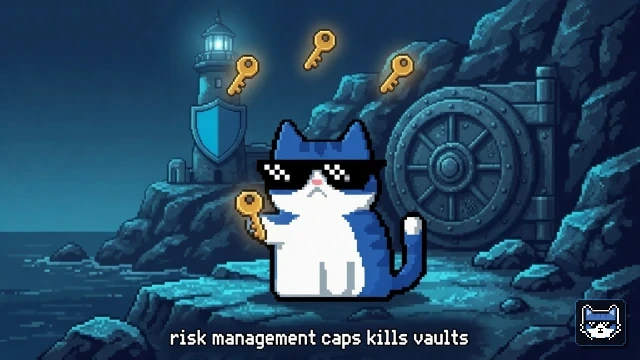


Bots execute faster than regret. That is good only if limits are faster still. Every automated path needs:
- Pre-trade checks (size, book, data health)
- Post-trade state updates (fills, inventory, remaining cap)
- Breakers on disconnects, stale marks, and bad data
If the feed dies, the system should stop taking risk, not "guess the last price." If a fill is partial, the state must say so. If you restart the process, it must recover positions instead of doubling them.
This is why risk is a product layer, not a blog post you read once. The machine that places the order has to know the cap.
Sizing Simple Rules That Work
- Risk a small fixed fraction of bankroll per idea
- Cut size after a kill event
- Never raise size because of a win streak unless a written rule says so
- Separate experimental size from full-size capital in the ledger
Streaks feel like skill. They are usually variance wearing a costume. Size-up should be a promotion with a sample gate, not a mood.
If two books share the same thesis, their combined size is the real size. Correlation is how people blow a "diversified" stack with one news print.
Review Risk Like You Review Edge
Weekly questions:
- Did any limit fire? Should it be tighter?
- Did we bypass a limit manually? Why?
- Did live risk match our size assumptions?
- Did we reopen a killed book the same day?
A bypass is a policy change you did not write down. Log it or it becomes the real system.
Review the kills you did not like. Those are the ones doing the job. If you never fire a limit, the limit is decoration. If you fire it and then re-arm the same day without a written cooldown, the kill was theatre.
Closing
Risk management for trading systems is boring by design. Boring keeps you in the game. Encode caps, kills, and spend limits before you automate ambition.
Chatito is for when you want to stop negotiating with yourself on every candle. Encode the rules. Prove them on paper. Arm live only when you mean it. Keys stay yours.
Join the waitlist if you want the system, not another feed.
Not financial advice. Trading involves risk of loss. Past results do not guarantee future performance.
FAQ
- What is risk management in a trading system?
- Predefined limits that stop oversized bets, cap losses, and halt automation when conditions break. It is encoded policy, not a feeling after a red day.
- What is a kill switch?
- A control that immediately stops new risk-taking (and often flattens or freezes books) when you or the system detect danger.
- Why use spend caps with AI?
- So the system cannot spend everything you own. Caps live on the strategy or on-chain as a signed, expiring rule. Keys stay yours. Chatito is not a vault and you do not deposit funds into us.
- Is position sizing part of risk management?
- Yes. Size is risk. Fixed fractional, max notional, and max concurrent books all belong in the risk layer.
- Can good risk rules make a bad strategy profitable?
- No. Risk rules keep you alive long enough to discover the strategy is bad and kill it. Survival is not alpha, but death ends the search.
- How does Chatito handle risk?
- Chatito is a system so you stop deciding every candle by mood. Caps and kills are part of that system. Paper first. You arm live. Keys stay yours. Not signals. Not a vault.
Not financial advice. Trading involves risk of loss. Paper ≠ live.